
Sergi, Duygu
Loading...
Profile URL
Name Variants
Job Title
Email Address
sergid@mef.edu.tr
Main Affiliation
02.01. Department of Industrial Engineering
Status
Current Staff
Website
ORCID ID
Scopus Author ID
Turkish CoHE Profile ID
Google Scholar ID
WoS Researcher ID
Research Topics
Domains
Social SciencesPhysical Sciences
Fields
Decision SciencesEngineeringBusiness, Management and AccountingComputer Science
Subfields
Management Science and Operations ResearchControl and Systems EngineeringStrategy and ManagementComputer Vision and Pattern RecognitionInformation Systems and Management
Specific Research Areas
Multi-Criteria Decision Making
Optimization and Mathematical Programming
Sustainable Supply Chain Management
Face and Expression Recognition
Technology Adoption and User Behaviour
Sustainable Development Goals
 1
1NO POVERTY
1
Research Products
 2
2ZERO HUNGER
0
Research Products
 3
3GOOD HEALTH AND WELL-BEING
0
Research Products
 4
4QUALITY EDUCATION
1
Research Products
 5
5GENDER EQUALITY
0
Research Products
 6
6CLEAN WATER AND SANITATION
0
Research Products
 7
7AFFORDABLE AND CLEAN ENERGY
1
Research Products
 8
8DECENT WORK AND ECONOMIC GROWTH
0
Research Products
 9
9INDUSTRY, INNOVATION AND INFRASTRUCTURE
1
Research Products
 10
10REDUCED INEQUALITIES
0
Research Products
 11
11SUSTAINABLE CITIES AND COMMUNITIES
1
Research Products
 12
12RESPONSIBLE CONSUMPTION AND PRODUCTION
1
Research Products
 13
13CLIMATE ACTION
0
Research Products
 14
14LIFE BELOW WATER
0
Research Products
 15
15LIFE ON LAND
0
Research Products
 16
16PEACE, JUSTICE AND STRONG INSTITUTIONS
0
Research Products
 17
17PARTNERSHIPS FOR THE GOALS
0
Research Products

This researcher does not have a Scopus ID.

This researcher does not have a WoS ID.
Publication Collaboration
| Affiliation Name | Count |
|---|---|
| Istanbul Technical University | 11 |
| MEF University | 9 |
| Wrocław University of Science and Technology | 2 |
| AGH University of Krakow | 2 |
| Southwest University | 1 |
1 / 2
Data obtained from OpenAlex

Scholarly Output
10
Articles
5
Views / Downloads
1038/129
Supervised MSc Theses
0
Supervised PhD Theses
0
WoS Citation Count
93
Scopus Citation Count
151
Patents
0
Projects
0
WoS Citations per Publication
9.30
Scopus Citations per Publication
15.10
Open Access Source
3
Supervised Theses
0
| Journal | Count |
|---|---|
| Studies in Systems, Decision and Control | 2 |
| Complex and Intelligent Systems | 1 |
| Eskişehir Teknik Üniversitesi Bilim ve Teknoloji Dergisi B - Teorik Bilimler | 1 |
| Journal of Intelligent & Fuzzy Systems | 1 |
| Journal of Intelligent and Fuzzy Systems | 1 |
Current Page: 1 / 2
Scopus Quartile Distribution
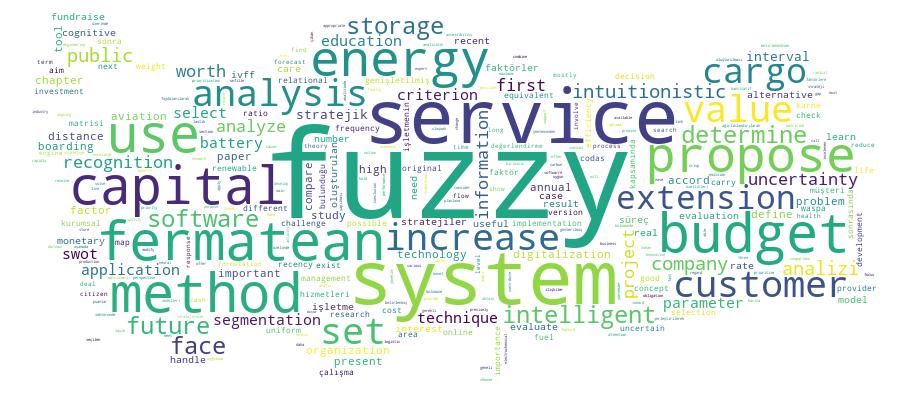
Competency Cloud
10 results
Scholarly Output Search Results
Now showing 1 - 10 of 10
Article Müşteri Hizmetleri Bölümünde Süreç Analizi ve Stratejik Planlama- Lastik Sektöründe Bir Uygulama(Eskişehir Teknik Üniversitesi, 2020-08-31) Özuduruk, Semih Faruk; Sergi, Duygu; Sarı, İrem UcalBu çalışma kapsamında, bir işletmenin süreç analizinin yapılması ve sonrasında işletme stratejisinin oluşturulması için gerekli analiz ve stratejik yönetim modelleri incelenmiştir. Daha sonra, işletme geneli için incelenen bu yöntemler, bir işletme özelinde müşteri hizmetleri bölümüne uygulanmıştır. Çalışma kapsamında, öncelikle SWOT analizi ile iş biriminin içinde bulunduğu mevcut durumun özellikleri belirlenmiş, sonrasında oluşturulan Genişletilmiş SWOT matrisi ile ortaya çıkan faktörlere uygun stratejiler belirlenmiştir. Stratejiler belirlendikten sonra İç Faktör Değerlendirme ve Dış Faktör Değerlendirme matrisleri ile SWOT analizinde ortaya konan faktörler ağırlıklandırılarak puanlanmıştır. Oluşturulan puanlar, İç-Dış Faktörler matrisine yerleştirilerek işletmenin bulunduğu stratejik konum tayin edilmiştir. Son aşamada ise, seçilen stratejiye ulaşmak amacı ile Kurumsal Karne (Balanced Scorecard-BSC) yönteminden faydalanılarak oluşturulan stratejik harita üzerinde faktörler arası ilişkiler gösterilmiş ve alt stratejiler belirlenmiştir.Book Part Citation - Scopus: 3Selection of the Best Face Recognition System for Check in and Boarding Services(Springer, 2021-08-27) Ucal Sarı, İrem; Sergi, Duygu; Kuchta, DorotaCheck-in and boarding services are one of the most human oriented pre-flight services in aviation industry. The process of using face recognition systems increase with the aviation 4.0 concept, decreases need for manpower and increases the efficiency of the processes. Therefore, problems, developments and challenges of face recognition in terms of aviation 4.0 are discussed in this chapter to determine the best face recognition system for check in and boarding systems. Analytic hierarchy process and grey relational analysis are used to analyze current system providers. To handle the ambiguity in the linguistic evaluations, fuzzy Z- numbers are used. 10 face recognition system providers are evaluated according to five criteria with the proposed methodology and the results are discussed. © 2022, The Author(s), under exclusive license to Springer Nature Switzerland AG.Book Part Citation - Scopus: 9Analysis of Intelligent Software Implementations in Air Cargo Using Fermatean Fuzzy Codas Method(Springer, 2021-08-27) Sergi, Duygu; Sarı, İrem Ucal; Kuchta, Dorota; Ucal Sari, IremThe chapter focuses on the problem of analyzing and selecting intelligent software in Air Cargo in the concept of Aviation 4.0. First, the notions, problems and challenges linked to air cargo are discussed. Recent developments, ongoing innovative projects and unfilled gaps in the area of intelligent air cargo software are presented. Next, the proposed method to analyze a select software to be used by air cargo companies is described. It is a modified version of one of the recent multi-criteria decision-making methods, called CODAS. Its original, crisp version and its existing fuzzy extensions are first presented. Next, an original extension of the method, using Fermatean fuzzy sets, is proposed. In the application section a logistics company is considered, which is facing the problem of selecting software supporting the air cargo process. The criteria are selected by experts holding various positions in the company, and three alternatives of air cargo software provider are determined. Then, the proposed method is applied to solve the intelligent software selection problem. Finally, conclusion and future research perspectives are given.Article Analysis of a New Business Model To Fundraise Non-Governmental Organizations Using Fuzzy Cognitive Maps(IOS Press, 2020-08-06) Aytore, Can; Sergi, Duygu; Ucal Sari, Irema; Sari, Irem UcalFundraising is one of the most critical issues for non-governmental organizations (NGOs) to carry out their projects. In this paper, a search engine project which aims to find additional financial sources and increase donations for NGOs is proposed. The proposed search engine project is analyzed using fuzzy cognitive maps (FCMs) to define and manage factor influences on the success of the project. FCMs are useful tools to define long term effects of important factors for a system. First casual relations of the factors are determined and then using sigmoid function for learning algorithm, the equilibrium state for the system is obtained. It is found that the factors generating monetary values are the most important ones for the project to be successful in long term.Article Citation - WoS: 62Citation - Scopus: 65Extension of Capital Budgeting Techniques Using Interval-Valued Fermatean Fuzzy Sets(IOS Press, 2021-12-31) Sergi, Duygu; Sarı, İrem Uçal; Senapati, TapanCapital budgeting requires dealing with high uncertainty from the unknown characteristics of cash flow, interest rate, and study period forecasts for future periods. Many fuzzy extensions of capital budgeting techniques have been proposed and used in a wide range of applications to deal with uncertainty. In this paper, a new fuzzy extension of the most used capital budgeting techniques is proposed. In this content, first interval-valued Fermatean fuzzy sets (IVFFS s) are defined, and the algebraic and aggregation operations are determined for interval-valued Fermatean fuzzy (IVFF) numbers. The formulations of IVFF net present value, IVFF equivalent uniform annual value, and IVFF benefit-cost ratio (B/C) methods are generated. To validate the proposed methods, proposed formulations are illustrated with a hypothetical example, and the results are compared with classical fuzzy capital budgeting techniques.Book Part Citation - Scopus: 1Interval Valued Intuitionistic Fuzzy Z Extensions of Ahp&codas: Comparison of Energy Storage Alternatives(Springer, 2023) Sergi, Duygu; Sarı, İrem Uçal; Ucal Sari, IremEnergy storage technologies are receiving increasing attention due to the trend toward renewable energy sources. Energy storage systems are a promising technology as they provide the low carbon emissions needed in the future, contribute to renewable energy production, and offer an alternative to petroleum-derived fuels. It is not possible to say precisely how the energy will be stored, and often more than one method must be used together. In this study, battery technologies from electrochemical energy storage systems are discussed. This chapter proposes a multi-criteria decision-making (MCDM) model combining fuzzy IVIF-Z-AHP and fuzzy IVIF-Z-CODAS methods to choose the optimal battery ESS. The priority weights of 4 main and 11 sub-criteria related to energy storage efficiency are determined using the IVIF-Z-AHP method. After that, 5 different batteries are evaluated using the IVIF-Z-CODAS method, and the most appropriate battery ESS is selected by doing a performance evaluation regarding the storage of energy at maximum efficiency.Book Part Customer Segmentation Using Rfm Analysis: Real Case Application on a Fuel Company(Emerald Publishing Limited., 2020-12-04) Ucal Sarı, İrem; Sergi, Duygu; Ozkan, BurcuCustomer segmentation is an important research area that helps organizations to improve their services according to customer needs. With the increased information that shows customer attitudes, it is much easier and also more necessary than before to analyze customer responses on different campaigns. Recency, frequency, and monetary (RFM) analysis allows us to segment customers according to their common features. In this chapter, customer segmentation and RFM analysis are explained first, then a real case application of RFM analysis on customer segmentation for a Fuel company is presented. At the end of the application part, possible strategies for the company are generated.Article Citation - WoS: 30Citation - Scopus: 42Prioritization of Public Services for Digitalization Using Fuzzy Z-Ahp and Fuzzy Z-Waspas(Springer, 2021-01-03) Ucal Sarı, İrem; Sergi, DuyguIn this paper, public services are analyzed for implementations of Industry 4.0 tools to satisfy citizen expectations. To be able to prioritize public services for digitalization, fuzzy Z-AHP and fuzzy Z-WASPAS are used in the analysis. The decision criteria are determined as reduced cost, fast response, ease of accessibility, reduced service times, increase in the available information and increased quality. After obtaining criteria weights using fuzzy Z-AHP, health care services, waste disposal department, public transportation, information services, social care services, and citizen complaints resolution centers are compared using fuzzy Z-WASPAS that is proposed for the first time in this paper. Results show that health care services have dominant importance for the digitalization among public services.Conference Object Citation - Scopus: 28Fuzzy Capital Budgeting Using Fermatean Fuzzy Sets(Springer, 2020-07-11) Sergi, Duygu; Sarı, İrem UcalInvestment projects are mostly evaluated by capital budgeting techniques to measure their profitability. The parameters used in capital budgeting such as future cash flows, interest rate and useful life involves high uncertainty due to the lack of information for the future environment. Since the uncertainty involved in forecasting the parameters is mostly in high levels, fuzzy set theory could be used in the determination of capital budgeting parameters to handle uncertain information in the analyses. Fermatean fuzzy sets are one of the most recent extensions of fuzzy set theory which are capable to handle higher levels of uncertainties by assigning fuzzy parameters from a larger domain. In this paper, fuzzy capital budgeting techniques that are fuzzy net present worth, fuzzy net future worth and fuzzy net annual worth are extended using fermatean fuzzy sets. An illustration for the calculations is also presented.Article Citation - WoS: 1Citation - Scopus: 3Evaluation of Learning Management Systems Using Interval Valued Intuitionistic Fuzzy-Z Numbers(Anadolu Üniversitesi, 2023-10-01) Ucal Sarı, İrem; Sergi, Duygu; Sari, Irem UcalThe use of online education tools has increased rapidly with the transition to distance education caused by the pandemic. The obligation to carry out all activities of face-to-face education online made it very important for the tools used in distance education to meet the increasing needs. In line with these needs, radical changes have occurred in the learning management systems used in distance education. Therefore, in this study, it is aimed to determine the features that the systems used in distance education should have and to compare the existing systems according to these features. For this purpose, a novel fuzzy extension, interval valued intuitionistic fuzzy Z-numbers, is defined for modeling uncertainty, and AHP and WASPAS methods using proposed fuzzy numbers are developed to determine the importance of decision criteria and compare alternatives.