
Saatçioğlu, Beken
Loading...
Profile URL
Name Variants
Saatçioğlu, Beken
Job Title
Email Address
saatcioglub@mef.edu.tr
Main Affiliation
04.04. Department of Political Science and International Relations
Status
Current Staff
Website
ORCID ID
Scopus Author ID
Turkish CoHE Profile ID
Google Scholar ID
WoS Researcher ID
Research Topics
Domains
Social Sciences
Fields
Social Sciences
Subfields
Political Science and International RelationsSociology and Political Science
Specific Research Areas
Turkey's Politics and Society
European Union Policy and Governance
Post-Soviet Geopolitical Dynamics
Political Conflict and Governance
Jewish and Middle Eastern Studies
Sustainable Development Goals
 1
1NO POVERTY
0
Research Products
 2
2ZERO HUNGER
0
Research Products
 3
3GOOD HEALTH AND WELL-BEING
0
Research Products
 4
4QUALITY EDUCATION
0
Research Products
 5
5GENDER EQUALITY
0
Research Products
 6
6CLEAN WATER AND SANITATION
0
Research Products
 7
7AFFORDABLE AND CLEAN ENERGY
0
Research Products
 8
8DECENT WORK AND ECONOMIC GROWTH
0
Research Products
 9
9INDUSTRY, INNOVATION AND INFRASTRUCTURE
0
Research Products
 10
10REDUCED INEQUALITIES
4
Research Products
 11
11SUSTAINABLE CITIES AND COMMUNITIES
0
Research Products
 12
12RESPONSIBLE CONSUMPTION AND PRODUCTION
0
Research Products
 13
13CLIMATE ACTION
0
Research Products
 14
14LIFE BELOW WATER
0
Research Products
 15
15LIFE ON LAND
0
Research Products
 16
16PEACE, JUSTICE AND STRONG INSTITUTIONS
4
Research Products
 17
17PARTNERSHIPS FOR THE GOALS
0
Research Products

This researcher does not have a Scopus ID.

This researcher does not have a WoS ID.
Publication Collaboration
| Affiliation Name | Count |
|---|---|
| MEF University | 9 |
| Schlumberger (Ireland) | 2 |
| Freie Universität Berlin | 2 |
| European University Institute | 2 |
| Istituto Affari Internazionali | 1 |
1 / 2
Data obtained from OpenAlex

Scholarly Output
24
Articles
7
Views / Downloads
1260/609
Supervised MSc Theses
0
Supervised PhD Theses
0
WoS Citation Count
114
Scopus Citation Count
147
Patents
0
Projects
1
WoS Citations per Publication
4.75
Scopus Citations per Publication
6.13
Open Access Source
9
Supervised Theses
0
| Journal | Count |
|---|---|
| E-International Relations | 1 |
| EU Good Governance Promotion in the Age of Democratic Decline | 1 |
| European Politics and Society | 1 |
| FEUTURE synthesis paper : the future of EU-Turkey relations: a dynamic association framework amidst conflictual cooperation | 1 |
| Global Affairs | 1 |
Current Page: 1 / 4
Scopus Quartile Distribution
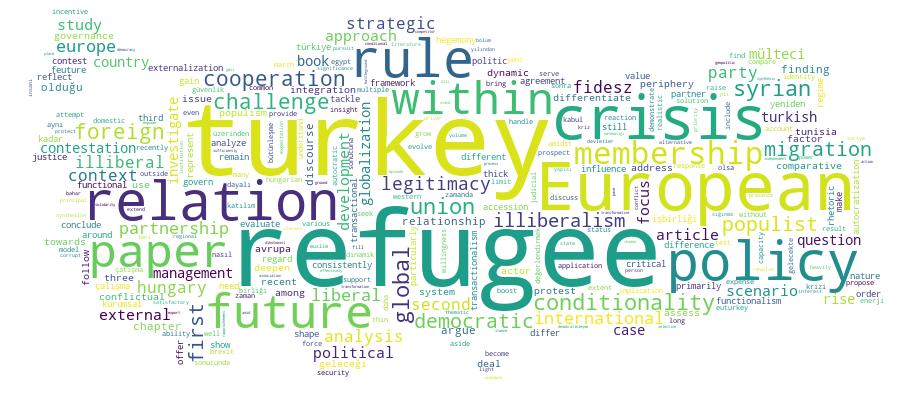
Competency Cloud
24 results
Scholarly Output Search Results
Now showing 1 - 10 of 24
Conference Object Comparing Right-Wing Populist Parties’ Stance towards the Global Management of International Migration: Insights from Turkey and Hungary(2024) Saatçioğlu, Beken; 01. MEF University; 04. Faculty of Economics, Administrative and Social Sciences; 04.04. Department of Political Science and International RelationsHow do ruling, right-wing populist parties approach the global management of international migration? This paper addresses this question by analyzing Hungary’s Fidesz and Turkey’s Justice and Development Party (AKP) in the context of the 2015 Syrian refugee crisis. It studies these parties’ discourses regarding the liberal international order (LIO) and the EU, and particularly, the latter’s proposed handling of the crisis. This fills a gap in the literature because ruling right-wing populist parties in middle-power states like Hungary and Turkey are seldom compared and the presence or absence of EU membership may make a difference in their arguments. The paper argues: (1) Fidesz and AKP selectively challenge the LIO and the EU within a populist foreign policy framework pitting “liberal, corrupt, global, EU elites” against the people (Christians for Fidesz, Syrian Muslim refugees for the AKP), (2) They differ because: (a) Fidesz’ challenges heavily focus on the EU while the AKP’s discourse extends to the global system and the UN, (b) Fidesz’ EU contestation revolves around the need to protect “Hungarian sovereignty” and “Christian European culture” from “Brussels elites” while AKP’s rhetoric primarily reflects expectations of satisfactory “transactionalism” from the EU.Book Part AB'nin Geleceği(Orion Kitabevi, 2022) Saatçioğlu, Beken; Saatçioğlu, Beken; 01. MEF University; 04. Faculty of Economics, Administrative and Social Sciences; 04.04. Department of Political Science and International RelationsBu bölüm, geçmişten günümüze AB’nin geleceği sorunsalını ele almaktadır. Her ne kadar AB’nin kurumsal yapısı, değer ve amaçları, karar alma süreçleri ve bütünleşme alanları tüm üye devletler tarafından kabul edilmiş olan 2009 Lizbon Antlaşması ile belirlenmiş olsa da, Birlik’in iç yapısı, üye devletler üzerindeki yetkileri, ve güncel sorun ve krizleri çözme kapasitesi son dönemde özellikle sorgulanır hale gelmiştir. AB’nin geleceği konusunun kısa bir tarihçesinin ardından, bölüm, 2010 yılından beri süregelen AB’nin çoklu krizlerinin AB’nin geleceğine ve gelecek tartışmalarına olan etkilerini incelemektedir. Sonuç bölümünde ise, AB’nin içinden geçmekte olduğu sınamaların sonucunda gelecekte nasıl bir yöne doğru evrilebileceği konusu kısaca irdelenmektedir.Conference Object A Comparative Analysis of Ruling Right-wing Populism towards Globalization in the Context of Refugee Crises: The Cases of Turkey and Hungary(2023) Saatçioğlu, Beken; 01. MEF University; 04. Faculty of Economics, Administrative and Social Sciences; 04.04. Department of Political Science and International RelationsHow do governing, right-wing populist parties in and outside the EU approach globalization on the issue of international migration? This paper addresses this question by focusing on Hungary’s Fidesz and Turkey’s Justice and Development Party (AKP) in the context of the 2015 Syrian refugee crisis. It studies the discourses of these parties and their leaders regarding the liberal international order and the EU, and evaluates whether EU membership makes a difference in these arguments. This fills a gap in the literature because how ruling right-wing populism in middle-power states like Hungary and Turkey challenges the global system, and what kind of globalization or de-globalization it asks for in the light of migration issues remains to be scrutinized. The paper argues: (1) Fidesz and AKP are both “selective globalizers” that still challenge globalization and the EU within a populist foreign policy framework pitting “liberal, corrupt, global, EU elites” against the people (Christians for Fidesz, Syrian Muslim refugees for the AKP), (2) They differ because: (a) Fidesz’ challenges heavily focus on the EU while the AKP’s discourse extends to the global system and its institutions (the UN), (b) Fidesz’ EU contestation revolves around the need to protect “Hungarian sovereignty” and “Christian European culture” from “Brussels elites” while AKP’s rhetoric primarily reflects expectations of satisfactory “transactionalism” from the EU.Article Turkey and the EU: Partners or Competitors in the Western Balkans?(2019) Saatçioğlu, Beken; 01. MEF University; 04. Faculty of Economics, Administrative and Social Sciences; 04.04. Department of Political Science and International RelationsThe article analyzes EU-Turkey relations in the Western Balkans (WB) in an attempt to uncover the cooperation and conflict potential between the two in the region. Specifically, it assesses the extent to which Turkey can be considered a partner of the EU versus representing acompetitor or even an alternative to Brussels for the WB countries. It argues that positing Turkey as a proactive, alternative regional power seeking to expand its presence and influence in the region at the EU’s expense are overstated.Despite the EU’s damaged credibility in the pursuit of its enlargement policy, Turkey’s capabilities, incentives and foreign policy priorities simply fall short of producing a competitive “Turkish model/alternative” in the region. First, there are practical limits to Turkey’s regional power status, which is far from representing a realistic substitute for the WB countries’ Euro-Atlantic ties. In addition, despite the difficulties ahead, these countries still aspire for integration into European structures, which is also aligned with Turkey’s foreign policy interests. Second, limitations aside, gaining hegemony in the WB is not Ankara’s foreign policy priority given the urgency of multiple policy issues waiting to be tackled on all fronts. Third, from a Realpolitik standpoint, Turkey and the EU are expected to constructively engage to find solutions for common challenges such as migration, which concerns the WB as well.Book Part Ab'nin Mülteci Krizi: Normlar-çıkarlar Dikotomisi Üzerinden Ab'yi Yeniden Değerlendirmek(İktisadi Kalkınma Vakfı, 2017) Saatçioğlu, Beken; 04.04. Department of Political Science and International Relations; 04. Faculty of Economics, Administrative and Social Sciences; 01. MEF University2011 yılından beri devam etmekte olan Suriye iç savaşının en kritik sonuçlarından biri hiç şüphesiz yol açmış olduğu insani krizdir. Suriye halkının daha güvenli ve iyi bir yaşam için öncelikli olarak sınırdaş Türkiye topraklarına, zaman içinde ise artan biçimde Avrupa ülkelerine sığınma çabaları ile ortaya çıkan mülteci sorunu, İkinci Dünya Savaşı’ndan sonra Avrupa’nın en vahim insani krizi haline gelmiş, bundan dolayı da “Avrupa’nın mülteci krizi” olarak nitelendirilmiştir. 2015’in bahar aylarından itibaren Akdeniz ve Ege üzerinden Avrupa’ya sistematik mülteci akınının artışıyla derinleşen kriz, AB içinde çok ciddi bir kriz yönetimi ve koordinasyon sorununu da beraberinde getirmiştir. Avrupa Komisyonu ve Almanya önderliğinde, Avrupa ortak sığınma sisteminin reforme edilmesi ve mültecilerin belirli kotalar doğrultusunda mevcut Üye Devletlerde yeniden yerleştirilmesi esaslarına dayanarak geliştirilmeye çalışılan “Avrupa çözüm planı”, yerini zamanla krizin Türkiye gibi üçüncü ülkelere havale edilerek dışsallaştırılması yoluyla çözülmesi çabalarına bırakmıştır.Book Part Citation - WoS: 3Turkey's Eu Membership Process in the Aftermath of the Gezi Protests(Amsterdam Univ Press, 2015) Saatçioğlu, Beken; Saatçioğlu, Beken; 04.04. Department of Political Science and International Relations; 04. Faculty of Economics, Administrative and Social Sciences; 01. MEF UniversityIn May 2013, a small group of protesters made camp in Istanbul's Taksim Square, protesting the privatisation of what had long been a vibrant public space. When the police responded to the demonstration with brutality, the protests exploded in size and force, quickly becoming a massive statement of opposition to the Turkish regime. This book assembles a collection of field research, data, theoretical analyses, and cross-country comparisons to show the significance of the protests both within Turkey and throughout the world.Book Turkey and the European Union: Key Dynamics and Future Scenarios(Nomos, 2021) Saatçioğlu, Beken; Saatçioğlu, Beken; 01. MEF University; 04. Faculty of Economics, Administrative and Social Sciences; 04.04. Department of Political Science and International RelationsThis volume studies the enduring complexity of EU–Turkey relations in all their thematic dimensions and with a view to offering future scenarios. It accomplishes three important aims. First, following a narratives analysis, the chapters analysing identity, politics, the economy, security, migration and energy identify the key dynamics that impact the relationship in these areas. Second, they evaluate how these drivers influence the three ideal-type future scenarios of convergence, cooperation and conflict, subsequently offering a relationship scenario for each thematic area. Third, the volume synthesises the chapters’ individual findings and argues that conflictual cooperation is the most likely scenario in future EU–Turkey relations. With contributions by İbrahim Semih Akçomak, Senem Aydın-Düzgit, Lorenzo Colantoni, Angeliki Dimitriadi, Atila Eralp, Erkan Erdil, Doruk Ergun, Hanna Lisa Hauge, Ayhan Kaya, Ebru Ece Özbey, Bahar Rumelili, Beken Saatçioğlu, Eduard Soler i Lecha, Melike Sökmen, Funda Tekin, Sinan Ülgen and Wolfgang Wessels.Article Citation - WoS: 1Citation - Scopus: 2Illiberal Challenges To the European Union's Legitimacy From Within and Without: the Rule of Law and Refugee Crises(Taylor and Francis Group, 2022) Saatcioğlu, Beken; Saatçioğlu, Beken; Gülmez, Didem Buhari; Buhari Gülmez, Didem; Soyaltin Colella, Digdem; 04.04. Department of Political Science and International Relations; 04. Faculty of Economics, Administrative and Social Sciences; 01. MEF UniversityThis study revisits the academic debate on rising populism and illiberalism in Europe that reduces the EU’s crises to those involving ‘liberal EU’ and ‘illiberal regimes’ without necessarily differentiating between these regimes. Applying Suchman’s multidimensional account of legitimacy to the EU, it unpacks the varying domestic contestations of two illiberal regimes against the different components of EU legitimacy within the context of two recent EU crises. Comparative analysis of how an illiberal insider (Hungary) and an illiberal outsider (Turkey) challenge the EU’s legitimacy in handling the rule of law and Syrian refugee crises, respectively, revealed two findings. First, Hungarian and Turkish actors raise divergent legitimacy contestations against the EU’s crisis management in the select cases. Second, their positionality towards the EU drives this divergence. While both countries seek to delegitimise the EU, their points of contention differ based on being in or outside the EU.Conference Object Contesting the EU’s Legitimacy over the Refugee and Rule of Law Crises: Insights from Turkey and Hungary(2022) Saatçioğlu, Beken; Soyaltin-Coella, Digdem; Saatçioğlu, Beken; 01. MEF University; 04. Faculty of Economics, Administrative and Social Sciences; 04.04. Department of Political Science and International RelationsThis paper studies how the representatives of illiberal governing parties in two illiberal regimes (Hungary and Turkey) challenge the EU from within (Hungary) and without (Turkey). Is there a variation in their contestations against EU legitimacy? Which issues do they converge or diverge about? What do their similarities and differences imply for the EU’s policies, external relations as well as European integration? To address these questions, the paper uses a bottom-up approach and brings into the analysis the perspectives of Hungarian and Turkish governing political actors in the context of two relevant EU crises which have arisen in recent years: the rule of law crisis and the refugee crisis.Conference Object Yeni Perspektifler: Türkiye-ab İlişkilerinin Matematiği ve Dili(2016) Saatçioğlu, Beken; Saatçioğlu, Beken; 04.04. Department of Political Science and International Relations; 04. Faculty of Economics, Administrative and Social Sciences; 01. MEF University...
- «
- 1 (current)
- 2
- 3
- »