
Şahin, Muhammed
Loading...
Profile URL
Name Variants
Sahin, M. & Şahin, Muhammed. & Şahin, Muhammed & Sahin, Muhammed. & Sahin, Muhammed & Şahin, M. & M. Şahin & M. Sahin
Job Title
Email Address
sahin@mef.edu.tr
Main Affiliation
02.04. Department of Civil Engineering
Status
Current Staff
Website
ORCID ID
Scopus Author ID
Turkish CoHE Profile ID
Google Scholar ID
WoS Researcher ID
No research topics data found.
Sustainable Development Goals
 1
1NO POVERTY
0
Research Products
 2
2ZERO HUNGER
0
Research Products
 3
3GOOD HEALTH AND WELL-BEING
0
Research Products
 4
4QUALITY EDUCATION
1
Research Products
 5
5GENDER EQUALITY
0
Research Products
 6
6CLEAN WATER AND SANITATION
0
Research Products
 7
7AFFORDABLE AND CLEAN ENERGY
0
Research Products
 8
8DECENT WORK AND ECONOMIC GROWTH
0
Research Products
 9
9INDUSTRY, INNOVATION AND INFRASTRUCTURE
2
Research Products
 10
10REDUCED INEQUALITIES
0
Research Products
 11
11SUSTAINABLE CITIES AND COMMUNITIES
1
Research Products
 12
12RESPONSIBLE CONSUMPTION AND PRODUCTION
0
Research Products
 13
13CLIMATE ACTION
0
Research Products
 14
14LIFE BELOW WATER
0
Research Products
 15
15LIFE ON LAND
0
Research Products
 16
16PEACE, JUSTICE AND STRONG INSTITUTIONS
0
Research Products
 17
17PARTNERSHIPS FOR THE GOALS
0
Research Products

Documents
23
Citations
337
h-index
10

Documents
23
Citations
22
No records found in other affiliations.

Scholarly Output
25
Articles
2
Views / Downloads
1804/358
Supervised MSc Theses
0
Supervised PhD Theses
0
WoS Citation Count
11
Scopus Citation Count
27
Patents
0
Projects
0
WoS Citations per Publication
0.44
Scopus Citations per Publication
1.08
Open Access Source
4
Supervised Theses
0
| Journal | Count |
|---|---|
| The flipped approach to higher education : designing universities for today's knowledge economies and societies | 14 |
| Innovation Technology and Education for Growth | 1 |
| KobiEfor Aylık Sanayi Ekonomi Dergisi | 1 |
| Natural Hazards | 1 |
| Rize Pazar | 1 |
Current Page: 1 / 2
Scopus Quartile Distribution
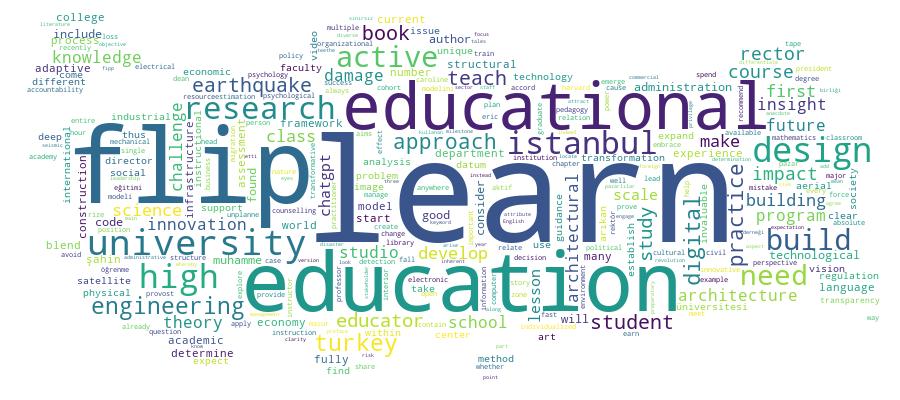
Competency Cloud
25 results
Scholarly Output Search Results
Now showing 1 - 10 of 25
Book Part Milestones for Success(Emerald Group Publishing Ltd., 2016) Kurban, Caroline Fell; Şahin, Muhammed…Book Part Flipped Leadership: Transparency, Vision, Accountability, and Resources(Emerald Group Publishing Ltd., 2016-11-18) Kurban, Caroline Fell; Şahin, MuhammedAs a founding rector of a new institution establishing itself as a fully Flipped university, both the university and I found ourselves in a unique position. Instead of a challenging, change-management process whereby buy in was needed from each stakeholder, all the staff, instructors, and students that started at MEF had come knowing that the education would be Flipped and had agreed to be a part of this approach. From a leadership point of view, this was indeed a privileged position to be in. However, it does not mean that there were not some teething problems along the way. Three main issues arose during the first year including; instructors’ expectations and the clarity of the MEF vision; issues related to the physical infrastructure; as well as questions about assessment.Other Laz Rektör Eğitimi Alt Üst Etti(Pazarlılar Derneği'nin Kültürel Yayını, 2016) Şahin, MuhammedMEF Üniversitesi Rektörü Prof. Dr. Muhammed Şahin, dünyada hiç bir üniversitede olmayan bir eğitim sistemini üniversitesinde uygulayarak bir ilke imza attı. Bir dönem İTÜ Rektörlüğü de yapan Şahin, Flipped Clasroom eğitim-öğretim modeli ile Türkiye'de eğitimi alt üst ettiklerini söylüyor. Akademi dünyasının tepkisi ise ilginçti: "Bu riski sadece bir Laz Rektör alabilirdi."Article Lessons From the Rector of the First Fully Flipped Learning University(FLR The Flipped Learning 3.0 Magazine, 2018) Şahin, MuhammedSahin: MEF Educational Institutions was founded in the 1970s by İbrahim Arıkan, an educator and businessman. In 1996, he founded MEF national and international K-12 schools in Istanbul and Izmir. In 2013, he founded MEF University. As both educator and entrepreneur, Arıkan was in a unique position to establish a university. He was aware the educational system was not well suited to the current needs of students and society and envisioned a totally new educational approach for MEF University. To find this approach, he brought me on board as founding rector. Having been rector of Istanbul Technical University from 2008 to 2012, I had a strong background in innovations in education. During our first meeting, Arıkan made it clear that if he was going to establish a university, it needed to be unique and take a different mentality to the educational needs of today’s students. I vividly remember Ibrahim emphatically declaring that if he could not make a change to higher education, he would call a halt to his aspirations for opening a university.Book Part How It Emerged That the Approach To Arts, Design, and Architecture Already Contains a Flip(Emerald Group Publishing, 2016) İnceoğlu, Arda; Sahin, Muhammed; Kurban, Caroline Fell; Kurban, Caroline Fell; Şahin, MuhammedArchitectural education is open to Flipping by its very nature. Since 19th century, design studios have been at the core of very different models of architectural education. Design studios have always been always active learning environments where students learn by doing. Typically, students are presented with design problems to which they need to develop personal solutions. Thus, from the very beginning of their studies, students simulate how an actual architect would approach design problems. With each new design studio, they develop new skills or hone the ones they have already acquired. Such an approach immediately creates a learning culture which is based on active learning where students are challenged to take responsibility, to solve complex problems and develop their individual character as designers while being able to work in group environments. A design studio is not a course where information is given an it is expected the students learn and use that information. It is a collaborative learning environment. Thus, following the lead of design studios, flipping theoretical courses within the architectural curriculum and making them active learning environments should be almost natural. However, this is not necessarily the case. There is a wide gap in pedagogical approaches used between design studios and theory courses within architectural education (Allen, 1997; Chiuini, 2006; Smith, 2004; Oakley, B, Felder, R M, Brent, R; Elhajj, I, 2004). Courses on architectural technology (structures, construction methods, detailing) and to a lesser extent courses on history and theory of architecture are taught in more conventional ways with little emphasis on the application of the information discussed (Vassigh, 2005, 2009). Within this context, it is important to find ways to develop non-studio courses as active learning environments.Book Part Cultural Aspects Inherent in Flipped Learning(Emerald Group Publishing Ltd., 2016) Kurban, Caroline Fell; Şahin, Muhammed…Other Aktif Öğrenme Modelini Kullanan Mef Üniversitesi’nin İddiası: “öğrenmede Sınırsız Özgürlük”(KobiEfor, 2020) Şahin, MuhammedMEF Üniversitesi, yüksek öğretimde dönüşümün anahtarı olarak kabul edilen Flipped Learning modelini ilk uygulayan kurum olarak ilk mezunlarını 2018’de verdi. Aktif öğrenme modelinde yetişen öğrencilerin mezuniyet sonrası işe girme ve öğrenime devam etme oranı yüzde 96’yı buldu. Üniversite bu yıl da finalleri kaldırarak proje haftasını getirdi.Book Part Citation - WoS: 1Organizational Design and Transformation(Emerald Group Publishing Ltd., 2016) Kurban, Caroline Fell; Şahin, Muhammed…Book Part The Flipped Approach To Higher Education : Designing Universities for Today's Knowledge Economies and Societies(Emerald, 2016) Kurban, Caroline Fell; Şahin, Muhammed; Şahin, Muhammedİçindekiler: List of Figures.--List of Tables.--Foreword.--Preface; About the Authors.--Chapter 1 The Socio-Economic and Socio-Technical Nature of Today's World and How This Impacts the Education Sector.--1.1. Employment.--1.2. Education.--1.3. Knowledge, Connectivity, and Cognitive Overload.--1.4. What is Needed from Education Today.--Chapter 2 Flipped Learning: A Transformative Approach Designed to Meet the Needs of Today's Knowledge Economies and Societies.--2.1. What is Flipped Learning?.--2.2. How Did Flipped Learning Develop?.--2.3. How Flipped Learning Meets the Needs of Today's Knowledge Economies and Societies.--Chapter 3 From Current Practice to Future Practice: Making the Decision to Flip.--3.1. Introduction.--3.2. Moving from Current Practice to Future Practice: How the Need for Change Emerged; 3.3. Searching for Future Practice; 3.4. The Big Reveal; Chapter 4 Organizational Design and Transformation; 4.1. Physical and Geographical Infrastructure; 4.2. Human, Social, and Intellectual Capital.--4.3. Technological Infrastructure.--Chapter 5 Flipped Learning Theory, Policies, and Practices.--5.1. Introduction.--5.2. Flipped Learning Theories.--5.3. Flipped Learning Performance Gaps, Causes, and Interventions.--5.4. From Theory to Practice.--5.4.1. A Recommended Course Design Process.--5.4.2. An Instructional Design Handbook.--5.4.3. A Flipped Learning Instructional Design Online Course.--5.4.4. A Flipped Learning Instructional Design Best Practice Checklist.--5.4.5. Support for Students.--5.5. Summary.--Chapter 6 Flipped Leadership: Transparency, Vision, Accountability, and Resources.--6.1. MEF University Rector, Muhammed Şahin. 6.2. Instructors' Expectations6.3. Physical Infrastructure; 6.4. Real-Life Assessment; 6.5. Conclusion; Chapter 7 Supporting Flipped Learning: Digital Pedagogy, Training, and Resources.--7.1. CELT, Caroline Fell Kurban.--7.1.1. Challenges through the Instructors' Eyes.--7.1.2. Challenges through the Students' Eyes.--7.1.3. Challenges through the Institution's Eyes: The Need for an Audit.--7.1.4. Lessons Learnt from the Audit: How the Process Could be Made More Supportive while Still Holding Instructors Accountable.--7.1.5. Lessons Learnt from Implementing Technological Mandates.-- 7.1.6. Where Next? Strategic Plan for the Rest of the Academic Year.--7.2. ITC, Brian Ramey.--7.2.1. The Technological Infrastructure Needed for a Flipped Environment.--7.2.2. Integrating Digital Resources.--7.2.3. Using Data to Effect Change.--7.2.4. The Need for a Secure Video Server.--7.2.5. Conclusion.--7.3. Library Director, Ertuğrul Çiman.--7.3.1. The Architecture of a Library in a Digital World.--7.3.2. The Successes of Using Digital Materials.--7.3.3. The Challenges of Using Digital Materials.--7.3.4. Academic Integrity in a Digital World.Book Part Flipped Learning in Legal Education: a Personal Experience(Emerald Group Publishing, 2016) Karacaoğlu, Emine; Sahin, Muhammed; Kurban, Caroline FellThere are always discussion on how legal education are to be taught interactively and effectively. Flipped learning are now considered as one of these methods engaging students in studies more effectively by way of pre-class activities and during the class discussions. This article in on a personal experience about this systems in legal education.
- «
- 1 (current)
- 2
- 3
- »